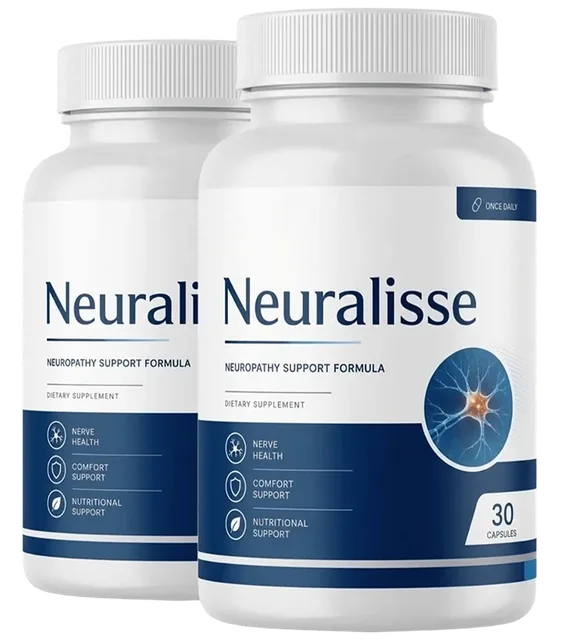
1 bottle
30 capsules in total · 30 days at one capsule daily, the serving the label gives
- 30 capsules, one a day
- Thirty days at the label serving
- Price shown at the checkout
- No price is published in any document supplied

Official product information
Neuralisse is a once-daily nerve support formula, made to support nerve comfort. A bottle holds 30 capsules, one a day. Each capsule gives 80 mg of magnesium (19% of the Daily Value) from a 575 mg blend of six ingredients, with alpha lipoic acid, L-carnitine, turmeric and coenzyme Q10. It is for adults and does not treat neuropathy or any disease.
Sold by the Official U.S. Neuralisse shop · read what to know before you buy.

Neuralisse is a capsule sold through this retail desk for daily nerve comfort. One bottle holds thirty capsules and the label says to take one a day, so a bottle is a month. The panel is the best this desk has read in the series: a declared nutrient with correct arithmetic — 80 mg of magnesium at 19% of the Daily Value — a complete caution block, a full Other Ingredients line, and a distributor with a city, a state, a ZIP, a telephone number and an email printed on the bottle. Then the arithmetic bites. The 575 mg Proprietary Blend names six ingredients, and the magnesium declaration fixes the weight of the first one at about 567.5 mg — 98.7% of the blend. Alpha lipoic acid, butcher’s broom, L-carnitine, turmeric and coenzyme Q10 share what is left: about 7.5 mg between the five of them. No price appears in any document supplied, and no guarantee length either.
This is an independent information desk. It sells nothing itself, it publishes what the label and the seller pack actually say, and where a fact was not supplied it says so rather than filling the gap. This product has the best label this desk has read in the series — which is exactly why it repays reading closely, because a good label gives a reader enough to do arithmetic with.
Only the first two of those four figures are printed on the bottle. The third is chemistry and the fourth is subtraction, and both are set out step by step further down this page.
Transcribed from the label artwork. Tap any row to read what that row’s research file actually says, and where the file comes from.
Tap any row
**Percent Daily Values are based on a 2,000 calorie diet. †Daily Value not established. Panel code ENB_430_01_061126.

Three rows, and the first two are the whole argument. A declared nutrient with a correct percentage sits above a blend total, and because the nutrient is sourced from inside the blend the two numbers are locked together. The label page sets out every row in full, alongside the suggested use, the caution block, the storage line and the distributor statement.
This is the analytical spine of the site. It uses two numbers printed on the bottle, one molar mass, and one sentence from the FDA’s labelling guide. Six steps.
On an ordinary proprietary blend a reader gets one number — the total — and the descending-order rule gives ceilings of total ÷ 1, ÷ 2, ÷ 3 and so on. Here those would be 575, 287.5, 191.7, 143.8, 115 and 95.8 mg: true, and nearly useless. Declaring 80 mg of magnesium above the blend and attributing it to the magnesium glycinate inside the blend does something far stronger. It fixes the first ingredient by chemistry rather than bounding it, and it collapses the other five into a 7.5 mg remainder. The ceilings that follow are between roughly 38 and 64 times tighter than the ordinary ones.
The first bar is the one ingredient whose weight is fixed by a printed figure. The second is everything else in the blend added together. The five below it are the ceilings the descending-order rule puts on each one inside that remainder. A ceiling is a ceiling, not an amount.
The top bar is not a ceiling. It is the weight the label’s own magnesium declaration forces, and it is 98.7% of the blend. Everything below the second bar is an upper limit the descending-order rule puts on a share of 7.5 mg. The ingredients page sets out all six rows in full.
Of the six names on this label, exactly one has a federal fact sheet that records the doses used in trials. It is L-carnitine, and it is fourth of six inside a 7.5 mg remainder.
The one ingredient on this label with a published study range, set against that range. NIH ODS records L-carnitine trials at “0.25 to 4 g/day”. The ceiling here is about 2.5 mg: between one hundred and one thousand six hundred times smaller. ODS also records that healthy adults do not need supplemental carnitine.
The arithmetic is 250 ÷ 2.5 = 100 and 4,000 ÷ 2.5 = 1,600. The ceiling on this label is between one hundred and one thousand six hundred times smaller than the doses in the trials the fact sheet describes. ODS adds a second line worth reading beside it: “Healthy children and adults do not need to consume carnitine from food or supplements.”
This section is a credit, and it is the longest one on the site. Magnesium is the one ingredient on this label with a federal file that speaks directly to nerves, and the amount declared is a sensible one.
The magnesium figure against the two numbers the NIH Office of Dietary Supplements publishes: a Daily Value of 420 mg, and a Tolerable Upper Intake Level of 350 mg for magnesium taken as a supplement. At 80 mg a capsule this product is at about 23% of that upper limit, which is a point in its favour.
“Magnesium … helps move calcium and potassium ions across cell membranes, a process that is important to nerve impulse conduction, muscle contraction, and normal heart rhythm … As magnesium deficiency worsens, numbness, tingling, muscle contractions and cramps, seizures … can occur.”
NIH Office of Dietary Supplements — Magnesium: Fact Sheet for Health Professionals — nerve function
Read that quotation carefully, because the difference matters. It describes what happens when a person does not have enough magnesium, not what happens when a person who has enough takes more. Numbness and tingling appear in it as signs of deficiency. A supplement that corrects a deficiency is doing something documented; the same supplement taken by somebody whose magnesium is already adequate is not covered by that sentence at all.
80 mg is about 23% of the 350 mg upper limit ODS sets for supplemental magnesium, so there is comfortable headroom below the level at which it records that high doses “often result in diarrhea”. Glycinate is among the better tolerated forms. And the panel’s own percentage is right — 80 ÷ 420 = 19.05%, printed as 19% — which is not something every label in this series manages. If magnesium is what a buyer wants, this is a real ingredient at a real amount.
The label and the marketing do not use the same word, and the difference between the two words is the difference between a supplement and a drug.

“Structure/function claims may describe the role of a nutrient or dietary ingredient intended to affect the normal structure or function of the human body … the disclaimer must state that the product is not intended to “diagnose, treat, cure or prevent any disease,” because only a drug can legally make such a claim.”
U.S. Food and Drug Administration — Structure/Function Claims
Neuropathy is a named medical condition. The bottle does not claim to address it: the front panel reads NERVE SUPPORT FORMULA, the three front icons carry asterisks, and the FDA disclaimer is printed in full. That is correct practice and this desk credits it. The graphic used to sell the product substitutes a disease word into the same bottle, twice. The label wins, because the label is the product. The full comparison is set out here.
Each is checked against a source linked from the label page. They are ordered by how much they should change a decision, not by how bad they look — and four of them are credits, because this label earns more than most.
The label gives one place of business and one contact route. The seller pack gives another of each, twice over. None of the three routes matches another.
The FDA’s required name and place of business, supplied in full. Most products in this series do not manage this.
A telephone number and an email on the bottle itself. Neither appears in the seller pack.
Two New York addresses, neither of which is the Colorado place of business on the label.
The order desk. The fourth brand this desk has received carrying that same number.
The first two lines are a genuine credit. The FDA requires a name and place of business on a supplement label, and this one supplies a city, a state and a ZIP, with a telephone number and an email beside them — which most products in this series do not. What follows is the problem: the order desk number in the pack, +1 (302) 200-3480, was supplied as the order line for three earlier products in unrelated categories. This is the fourth. Every published route is printed on the contact page.
Ten reviews and ten portraits came with this product. This site publishes no rating, no review count and no testimonials — and publishes all ten reviews and all ten portraits anyway, because what is wrong with them is the finding.
Every opening and every closing matches, word for word and in the same order, a set supplied with a product in a different category earlier in this series. The names, ages, towns and sexes differ; the sentences do not. This is the clearest finding on the page because it needs no judgement — both sets are printed side by side below.
All ten close with two sentences of the form “I keep it somewhere. I take it at some trigger.” Ten different people, ten different lives, one sentence pattern repeated without exception.
Bonnie travels for installs and keeps it by the hymnals. Lawrence has a garage workshop and keeps it on the sewing table. Wade bakes at five and keeps it on the barn nail. The closings read as though drawn from a pool and attached to whichever opening came up.
The full audit is on the reviews page, with both sets printed side by side, all ten texts, and the two further tells. Nothing anywhere on this site presents any of it as customer testimony.
Answer these six and this page will tell you which of three positions you are in. Nothing is stored and nothing is sent; the questions run in your browser.
Are you buying this mainly for nerve symptoms you already have?
Has a clinician told you what is causing them?
Do you take a blood thinner, insulin or any prescription medicine?
Do you already take a magnesium supplement?
Would you be comfortable paying a price you cannot see until checkout?
Have you read the Supplement Facts panel rather than the sales graphic?
Nothing here is stored, sent or remembered. The verdict is worked out in your browser as you go.
One of the six carries more weight than the others. Nerve symptoms that have not been explained by a clinician are a reason to see one, not a reason to buy a supplement. Numbness and tingling have many causes, and some of them need treating.

1 bottle
30 capsules in total · 30 days at one capsule daily, the serving the label gives


3 bottles
90 capsules in total · 90 days at one capsule daily, the serving the label gives


6 bottles
180 capsules in total · 180 days at one capsule daily, the serving the label gives

Every pack: sealed bottles · Guarantee as printed at checkout · returns to 4 Times Square, Floor 22, New York, NY 10036, USA · order support +1 (302) 200-3480
There is no price comparison on this page because there is no price. The seller pack’s instruction to this desk was “Print live checkout prices. Do not guess.” and no figure for a bottle, a pack or shipping appears in any document supplied. What can be said is the supply: thirty capsules a bottle at one a day is thirty days, so six bottles is a hundred and eighty days of product bought against a guarantee whose length is also not published. The pricing page sets out what that means for a buyer.
Four moments, and one of them cannot be dated because the document that would date it does not exist.
The pack says only that the guarantee is “As printed on the live checkout”. It gives no window, no condition and no exclusion, which means no date can be put in a calendar from anything supplied to this desk. It does give a procedure, two addresses and refund timings, which is more than nothing. Photograph the checkout screen before you pay, because it is the only record of what you agreed to. What is and is not published is set out here.
Six categories, marked out of five, published with the reasoning rather than as a number on its own.
2.4 out of 5. The shape matters more than the total, and this one is unusual in the series: label completeness and ingredient naming both score 4, the highest marks this desk has given. There is a real Supplement Facts panel, a declared nutrient with correct arithmetic, a complete caution block, a full Other Ingredients line, two binomials with plant parts and one standardisation. What drags the total down is what that good label turns out to say — 98.7% of the blend is one ingredient — and what sits around it: no price, no guarantee length, a disease word in the artwork, and ten reviews whose every sentence was also supplied for a different product.
A bound for each, and what each ingredient’s file actually says at the two federal bodies this desk reads. Tap through for the full entry.
Forced by the 80 mg magnesium declaration. 98.7% of the blend.
Alpha Lipoic Acidno binomial; a compoundat most 7.5 mgNo fact sheet at NCCIH or NIH ODS. A ceiling, not an amount.
Butcher’s Broom root extractRuscus aculeatusat most 3.7 mgGenus, species and plant part printed. No federal fact sheet.
L-Carnitineno binomial; a compoundat most 2.5 mgNIH ODS records trials at 250 to 4,000 mg a day.
Turmeric rhizome extract, 95% curcuminoidsCurcuma longaat most 1.9 mgThe best-specified name on the label. NCCIH is blunt about the evidence.
Coenzyme Q10 (ubiquinone)no binomial; a compoundat most 1.5 mgA documented warfarin and insulin interaction, unmentioned on the label.
Four of the six have a federal fact sheet — magnesium and L-carnitine at the NIH Office of Dietary Supplements, turmeric and coenzyme Q10 at NCCIH. Alpha lipoic acid and butcher’s broom return nothing at either. This site therefore publishes no dose and no effect for those two, and will not borrow one from a journal.
This is the useful part of the site, and it costs an email or a telephone call. The label prints +1 (323) 403-4725 and [email protected]. The seller pack gives a different number, +1 (302) 200-3480. Try both.
The batch page has the full call script, including what a good answer looks like and what it means if nothing arrives.
These are the questions people actually type about this product. Each answer is sourced, or says plainly that nothing is published. Type to filter.
A capsule dietary supplement sold for daily nerve comfort. Thirty capsules a bottle, one a day, so a bottle is a month. The front panel reads NERVE SUPPORT FORMULA with three asterisked icons — nerve health, comfort support, nutritional support — and the FDA disclaimer printed in full. It is distributed by Neuralisse, Aurora, CO 80011, and sold through the seller’s own checkout. It is a supplement, not a drug, and no document supplied claims otherwise.
Per capsule: 80 mg of magnesium at 19% of the Daily Value, declared above a 575 mg Proprietary Blend of six ingredients — magnesium glycinate, alpha lipoic acid, butcher’s broom (Ruscus aculeatus) root extract, L-carnitine, turmeric rhizome extract at 95% curcuminoids, and coenzyme Q10 as ubiquinone. The other ingredients are hypromellose, microcrystalline cellulose, magnesium stearate, stearic acid and silicon dioxide. No per-ingredient amount is printed for any of the six.
Eighty milligrams of elemental magnesium, printed on the panel, at 19% of the Daily Value. That percentage is correct: the NIH Office of Dietary Supplements gives the Daily Value as 420 mg, and 80 ÷ 420 is 19.05%. ODS also sets the Tolerable Upper Intake Level for supplemental magnesium at 350 mg a day, so one capsule is about 23% of that limit. That is a sensible amount and this desk records it as a credit.
Only one figure is printed, and it belongs to the declared nutrient rather than to a blend row. But it solves the blend. Magnesium bisglycinate is 14.1% magnesium by weight, so 80 mg of magnesium needs about 567.5 mg of the chelate — out of 575 mg. That leaves about 7.5 mg for the other five together. Inside that remainder the descending-order rule caps them at about 7.5, 3.7, 2.5, 1.9 and 1.5 mg. Every one of those is a ceiling, not an amount.
Nothing published answers that for the product as a whole: no clinical trial of Neuralisse exists, and no document supplied claims one. What can be checked is the ingredient level. Magnesium has a real federal file — NIH ODS records it as “important to nerve impulse conduction” — and that file is about correcting a deficiency, not about relieving symptoms in someone who has enough. The other five are present in a combined 7.5 mg.
This desk does not use that word, and the label does several things a careless operation would not: correct Daily Value arithmetic, a complete caution block, a full Other Ingredients line and a real place of business with a telephone number and an email on the bottle. What is wrong sits around the label. All ten supplied reviews repeat a set supplied for an unrelated product, the order desk is the fourth brand on one number, and no price is published anywhere.
The label’s own caution is complete: do not exceed the recommended dose, not for under-18s or pregnant or nursing mothers, and consult a physician before use if you take a medication or have a medical condition. Beyond that, NIH ODS records that high doses of supplemental magnesium “often result in diarrhea”, and NCCIH records that CoQ10 “may interact with the anticoagulant (blood thinner) warfarin and the diabetes drug insulin”. The word warfarin appears nowhere on the product.
No dietary supplement is. In the FDA’s own words: “Under DSHEA, FDA does not have the authority to approve dietary supplements before they are marketed.” The label prints the mandatory disclaimer in full and makes no approval claim. A Good Manufacturing Practice seal and a non-GMO seal were supplied as separate artwork; neither appears on the bottle, neither names a certifying body and neither carries a registration number.
The bottle does not say that, and this page will not. The label reads NERVE SUPPORT FORMULA. It is the Inside Neuralisse marketing graphic that renders the same bottle as a NEUROPATHY SUPPORT FORMULA. Neuropathy is a named medical condition, and the FDA is explicit that a supplement may not claim to treat one because “only a drug can legally make such a claim”. Nerve symptoms a clinician has not explained are a reason to see one.
Not published. The seller pack’s own instruction to this desk was “Print live checkout prices. Do not guess.” No figure for a bottle, a pack or shipping appears in any document supplied, so none is printed on this site. The price is shown at the checkout, and that screen is the only place it exists. The pack names a top pack of six bottles without pricing it.
The pack says the guarantee is “As printed on the live checkout” and gives no window, no length and no conditions. It does give a procedure: send your full name, email and order ID, the buyer pays return shipping with tracking, the refund follows 3 to 5 business days after the return is credited and then 5 to 10 days to reach the card, and returns go to the Times Square address. Read the checkout screen before you pay.
This desk cannot verify any of them, and publishes all ten so a reader can judge. The finding is blunt: every opening and every closing of the ten supplied with this product matches, word for word and in the same order, a set supplied with a product in a different category earlier in this series — with different names, ages, towns and sexes attached. Both sets are printed side by side on the reviews page.
One capsule a day. The printed instruction is the whole of it: “As a dietary supplement, take one (1) capsule daily.” The label sets no time of day, gives no food instruction and states no maximum. Storage is “a cool dry place below 30 degrees C (86 degrees F)”, out of reach of children, and the label says not to use the product if the safety seal is damaged or missing. The directions page covers the rest.
Add the figures together before you decide. One capsule carries 80 mg of magnesium, and NIH ODS sets the upper limit for supplemental magnesium at 350 mg a day, recording that higher intakes “often result in diarrhea”. One capsule is about 23% of that. A separate magnesium tablet of 200 or 400 mg beside it changes the arithmetic entirely. The label itself says to consult a physician if you take a medication.
Not published. The label names a distributor — Neuralisse, Aurora, CO 80011, USA, with a telephone number and an email beside it — which is the FDA’s required name and place of business, supplied in full and more than most products in this series manage. What it does not name is a manufacturer, and it gives no country of origin for the ingredients. No GMP statement is printed on the bottle.
Nobody yet, and the byline says so on every page. The author line is this desk; the reviewer line is a visibly empty bracket until a named person has read these pages. The seller pack supplied a real podiatrist’s name to print there. Nothing supplied shows that he read anything on this site, so his name is not used. The about page explains the slot.
Thirty capsules, one a day, and the best label this desk has read in the series. The panel declares 80 mg of magnesium at 19% of the Daily Value above a 575 mg blend of six ingredients — and that one printed figure fixes the first ingredient at about 567.5 mg, leaving roughly 7.5 mg for the other five together. No price appears in any document supplied.
No price appears in any document supplied to this desk, as of October 11, 2026, so none is printed here. The checkout screen is the only place a price exists. Questions first? Every published contact route is here.
Authorship and review
Last updated October 11, 2026. A highlighted slot is a value no human has supplied yet. Who reviews these pages?